The search bar that sells, now thinks fast and slow
A good salesperson does not think out loud. She glances, and she knows.
It is the Saturday before Mother’s Day, a little after eleven, and the florist from issue 1 has a queue to the door. The cold room smells of eucalyptus. Someone’s phone keeps ringing. A woman near the front says “something for my mum, she loves yellow, not too big, I’m on the bus,” and before she has finished the sentence the florist is already reaching for the yellow roses by the window.
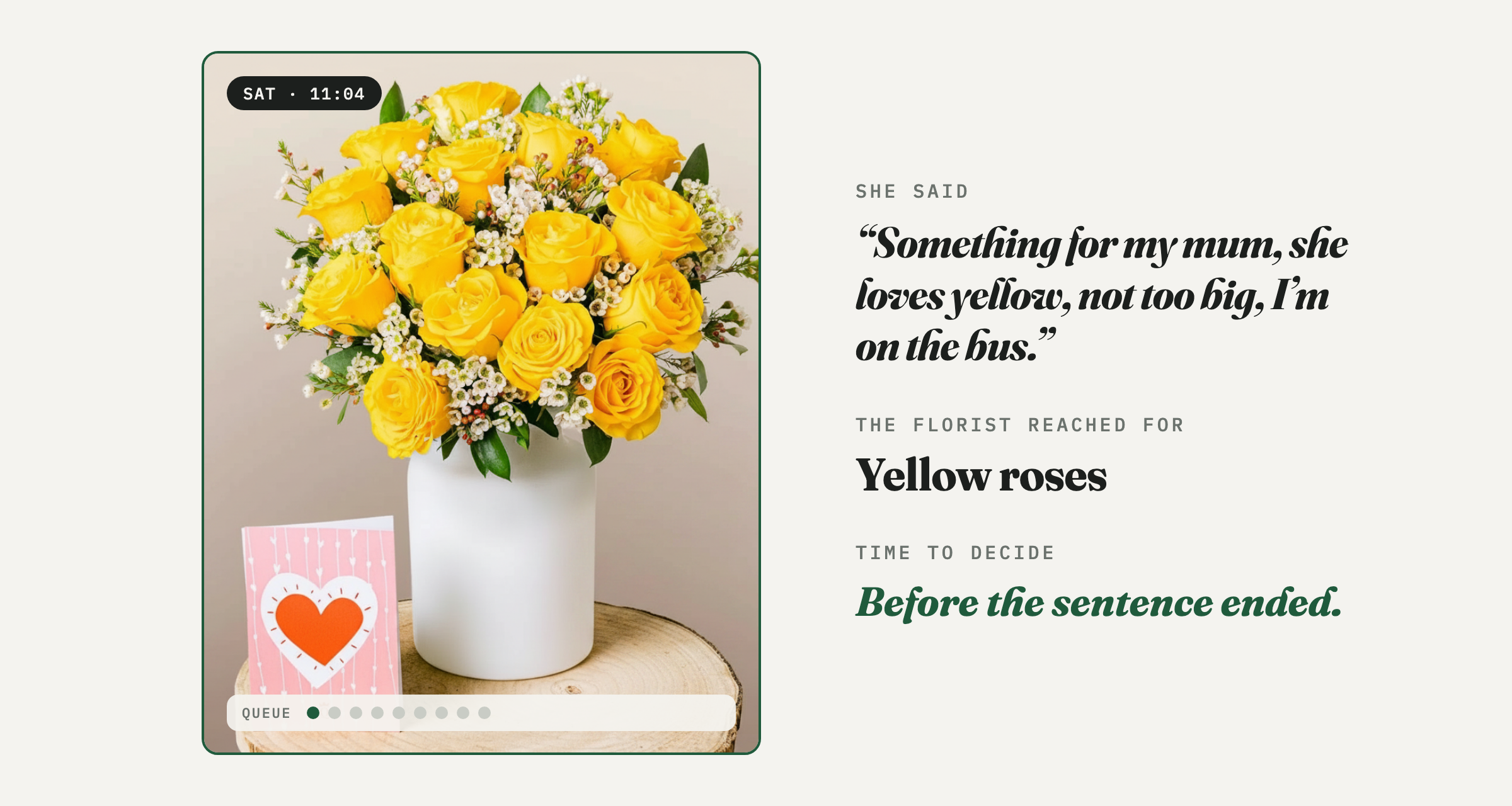
She did not stop to consider every stem in the shop. She did not reason it through in her head, bucket by bucket, and then announce a ranking. She looked at the shelves she already knows, asked herself a few quick questions about each, and her hand went to the right place. Yellow, yes. Small, yes. Survives a bus ride, yes.
Our search bar could already do what she does. In issue 1 it learned to listen, to walk to the right shelf, to pull a handful and to hold up the best one. What it could not do was keep up with the queue.
The slow step
Of the four steps, the last one was the slow one. Holding up the best one meant handing the shortlist to a careful thinker and asking it to read every candidate and write out the order. It was good at that. It noticed that “nothing too big” rules out the tall arrangement by the door, and that an anniversary wants something that says so.
It also took its time, the way a careful person writing a thoughtful note takes time. Most of the time that did not show. A question someone has asked before comes back from memory, and on the live flower shop those answers arrive in under a second on average. The hard case is the cold one: the first time anyone asks for yellow, not too big, for the bus. Then every step runs from scratch, and the careful thinker was the longest of them. A clerk who pauses to compose a review before saying “I have just the thing” is a clerk the woman on the bus does not wait for.
You can try to fix that by asking the same careful thinker to hurry. You get the same answer, worse. Or you try a quicker, smaller thinker and get the suitcase back. Both of those treat the problem as speed. It is really a problem of shape.
A questionnaire, not an essay
Look again at what the florist did. She did not write an opinion. She answered a few small questions, all at once, about each thing in front of her. Does this fit what she asked for? Of everything here, is this one of the three I would show? The order of the bouquets on the counter is simply what those answers add up to.
That is a very different job from writing an essay, and there are models built for it. The one we use is called JEV. You give it a scene and a list of short questions, and it answers every question at once, each answer a number rather than a paragraph. There is nothing to read back, nothing to parse, and nothing to wait for in between. For a shortlist of thirty bouquets it answers sixty questions in roughly a third of the time the careful thinker took to write its review.
The careful thinker wrote a review of the shelf. JEV fills in a questionnaire about it. The second one is the florist’s glance.
So the fourth step changed shape. The search bar still listens, still walks to the shelf, still pulls a handful. Then, instead of waiting for the review, it asks each candidate its questions and adds up the answers.
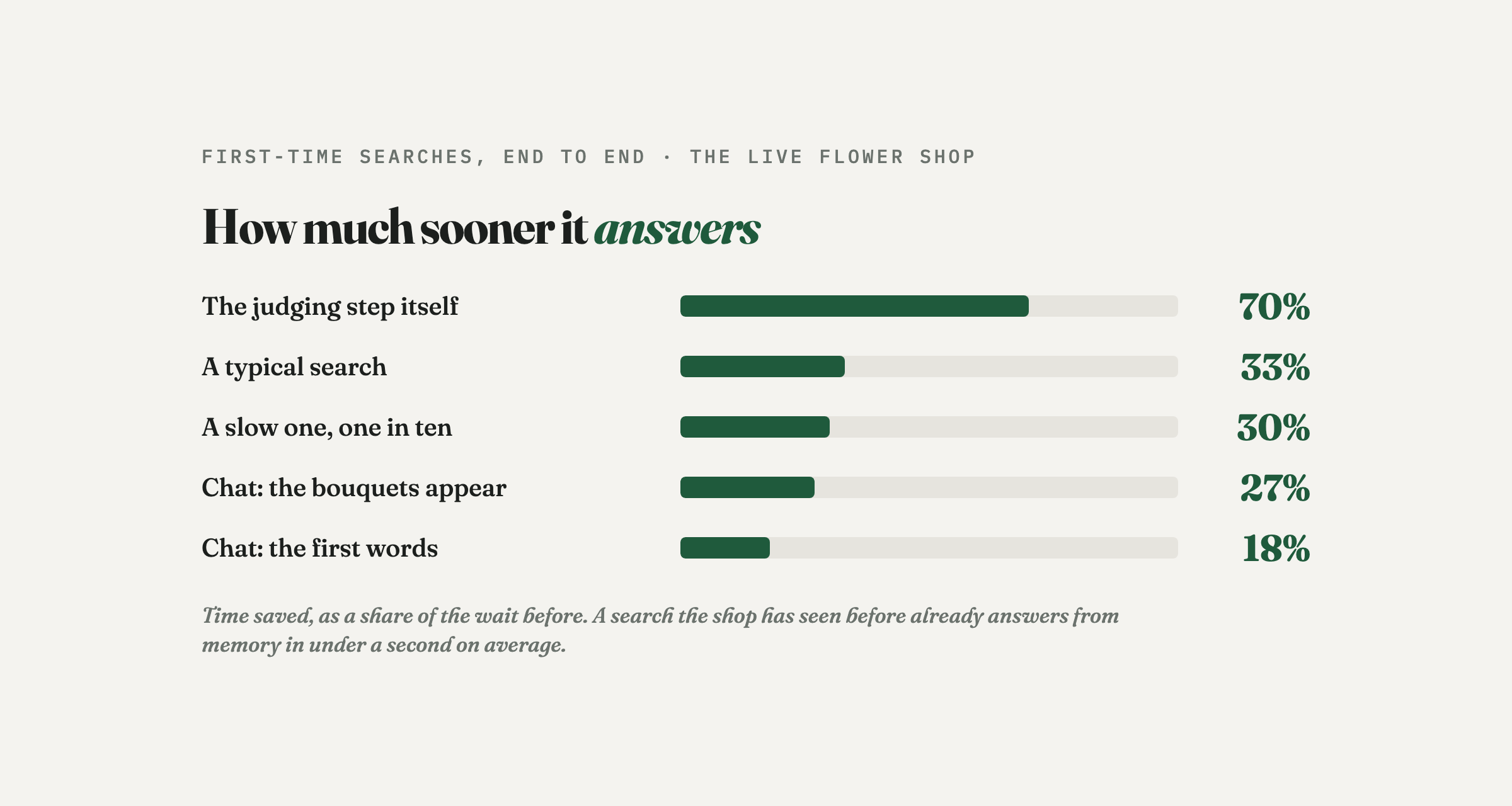
A third off the wait, on exactly the searches that used to make people wonder whether to scroll the category page instead. The judging step, the one that used to dominate, is now the smallest part of it. That is the difference between a search bar that feels like asking a person and one that feels like waiting for a page to load.
Thinking fast and slow
Daniel Kahneman described two ways we think: a fast one that glances and knows, and a slow one that reasons it through in words. The florist uses both. She glances at the shelf, and she talks to the woman on the bus.
The search bar now works the same way. The slow thinker still does what it is good at: it listens to the sentence and writes down who the gift is for, the occasion, the budget and what must be true. JEV does the glancing.
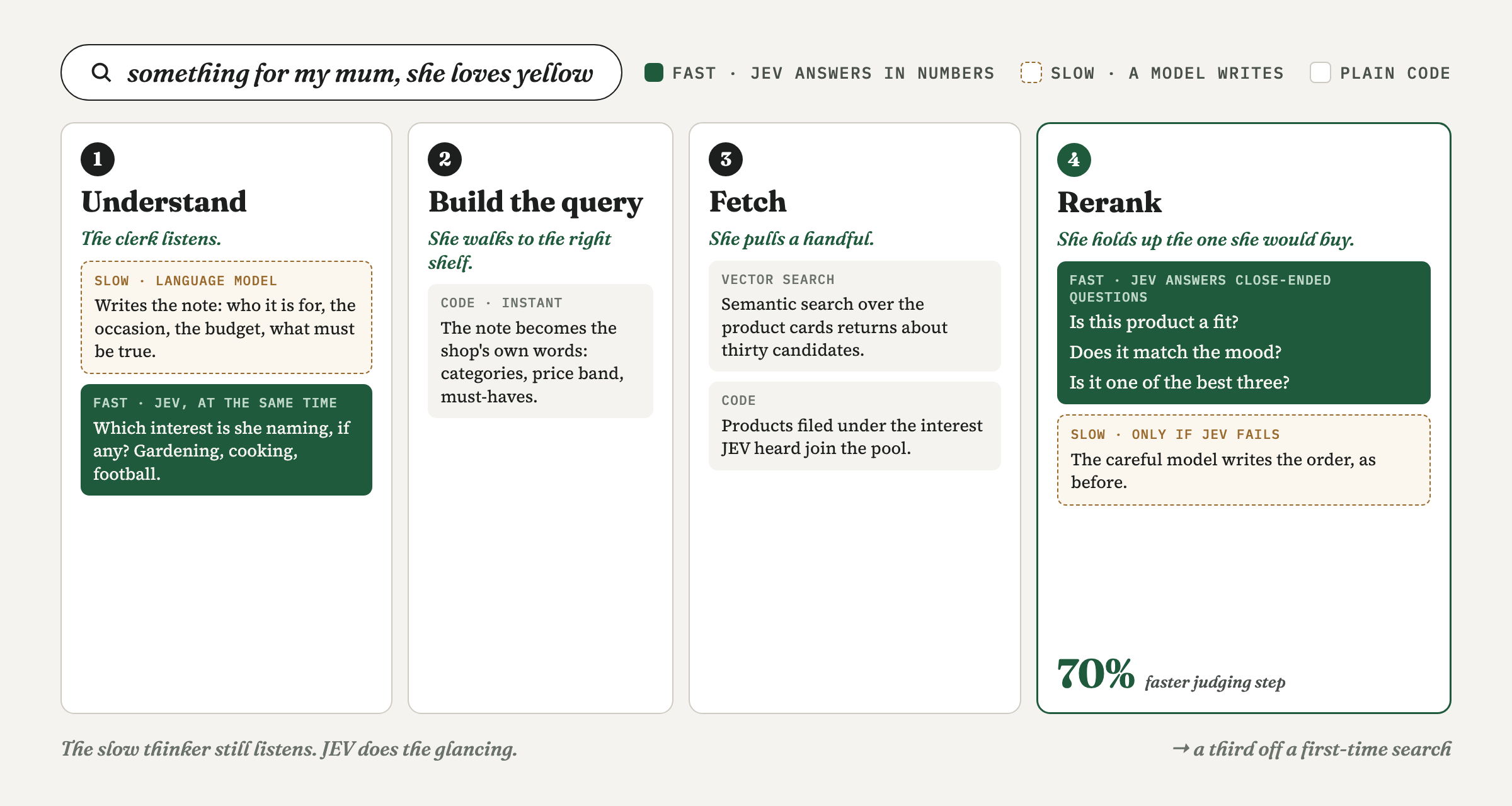
It glances twice. While the slow thinker is still writing its note, JEV hears whether the shopper named an interest, a gardener or a football fan, so the products filed under it join the handful. Then, at the counter, it answers every candidate’s questions in a single request, and the order is the sum of the answers. If that answer ever fails to arrive, the slow thinker steps back in and writes the order the old way, so the search bar is never left without one.
Each step got the kind of thinking its job needs: words where something has to be understood, numbers where something only has to be judged.
Keeping her taste
A faster glance is only worth having if it still lands on the right bouquet. A questionnaire is only as good as its questions, so most of the work went into asking better ones and handing over better context.
Hear the number the way it was meant. “Around fifty” is a range, not a ceiling. A florist shows you something at fifty-five without blinking. The search bar now hears “around” as roughly a third either side, so the nice option just above the number still makes the counter.
Know what a feeling looks like. This one surprised me. Ask a flower shop for “something romantic” and nearly every bouquet in it describes itself as romantic. The fit question cannot tell them apart, so the first quick version of the search bar showed a bouquet with “romantic” in its name and the cheapest roses. The careful thinker had known better, the way any florist does: romantic means generous red roses. So we added one more question, asked only when the shopper names a mood. How strongly does this one say it? It costs a few hundredths of a second, and the red roses came back to the front of the counter.
None of those needed a smarter model. Each is a question, or a piece of context, that the person behind the counter would have had in her head.
Where she goes next
The same glance now sits inside the shopping assistant too, so a conversation that starts with a wish reaches the right flowers sooner. And because each answer is a number, a new question costs hundredths of a second rather than seconds. That changes how you improve the system. Instead of rewriting a long instruction and hoping, you add a question, watch what it moves, and turn it up or down.
What is left of the cold wait now lives in the first two steps, listening and fetching. That is the next tuning story.
The takeaway
When an AI step is too slow, the instinct is to look for a faster model. Look at the shape of the question first. A judgement does not have to be an essay. Break it into the small questions an expert asks without noticing, let each one answer with a number, and the order falls out of the sum. Speed comes from the shape of the work, taste comes from choosing the questions, and every question you add is one more knob on the system.